Heroku vs Vercel: Choosing the right platform for your app
When it comes to deploying web applications, developers face issues picking from the huge list of cloud platform options. Two popular choices that frequently come up in discussions are Heroku and Vercel, each offering distinct approaches to application hosting and deployment. Understanding the differences between these platforms is crucial for making an informed decision that aligns with your project's needs, budget, and technical requirements.
This Heroku vs Vercel comparison examines the factors that impact your choice: architectural paradigms, deployment workflows, primary use cases, cost structures, and security models.
Heroku vs Vercel: Things to consider
Before diving into the specifics, it's important to understand the fundamental positioning of these platforms. Heroku, acquired by Salesforce in 2010, was one of the original Platform as a Service (PaaS) providers, designed to simplify application deployment across a wide range of technologies and frameworks. Vercel, on the other hand, emerged from the modern frontend ecosystem, initially created by the team behind Next.js to provide an optimal deployment experience for JavaScript and TypeScript applications.
When evaluating these platforms, consider your application's architecture, your team's expertise, scalability requirements, and budget constraints. Heroku excels at supporting traditional server-based applications and offers extensive support for multiple programming languages, including Ruby, Python, Java, PHP, Node.js, and Go. Vercel has carved out a strong niche in the frontend and full-stack app ecosystem, with exceptional support for Next.js, React, Vue, and other frontend frameworks.
The choice between them often comes down to whether you're building a traditional backend-heavy application with potentially complex server requirements, or a modern frontend-first application with serverless API routes. Your team's familiarity with the deployment paradigm also matters. Heroku follows a more traditional server-based model, while Vercel embraces serverless computing and edge computing principles.
Selling point
Heroku’s core selling point is operational simplicity for backend-heavy applications. It abstracts servers, scaling, and infrastructure into a mature PaaS with first-class support for long-running processes, background workers, scheduled jobs, and managed add-ons (Postgres, Redis, etc). If you are building traditional web apps, APIs, or worker-based systems, Heroku lets you focus on application logic and backend logic instead of platform mechanics.
Vercel's main selling point is frontend velocity and deployment confidence. It is tightly integrated with modern frameworks (especially Next.js) and offers instant global deployments, edge rendering, and preview deployments for every pull request (even though Heroku has a similar feature, review apps). Vercel is optimized for frontend apps and provides serverless infrastructure that scales automatically. For engineers prioritizing frontend performance, DX, and rapid feedback loops, look no further than Vercel.
Architectural differences between Vercel vs Heroku
The architectural philosophies of Heroku and Vercel diverge significantly, which shows their different strengths and target audiences.
Heroku operates on a dyno-based architecture. Dynos are lightweight Linux containers that run your application code. When you deploy to Heroku, your application runs on one or more dynos, which can be scaled horizontally by adding more dynos or vertically by upgrading to more powerful dyno types. This model is conceptually similar to running your application on traditional servers, but with the abstraction and convenience of a managed platform. Heroku also provides a robust add-on ecosystem, allowing you to attach databases, caching layers, monitoring tools, and other services to your application with minimal configuration.
Vercel, in contrast, embraces a serverless architecture with a strong emphasis on edge computing. When you deploy a frontend application to Vercel, your static assets are distributed across a global Content Delivery Network (CDN) for fast load times, regardless of user location. For dynamic functionality, Vercel uses serverless functions that execute on demand without requiring you to manage any server infrastructure. This serverless computing model is particularly efficient for full stack apps that combine static websites with API endpoints.
Deployment workflows
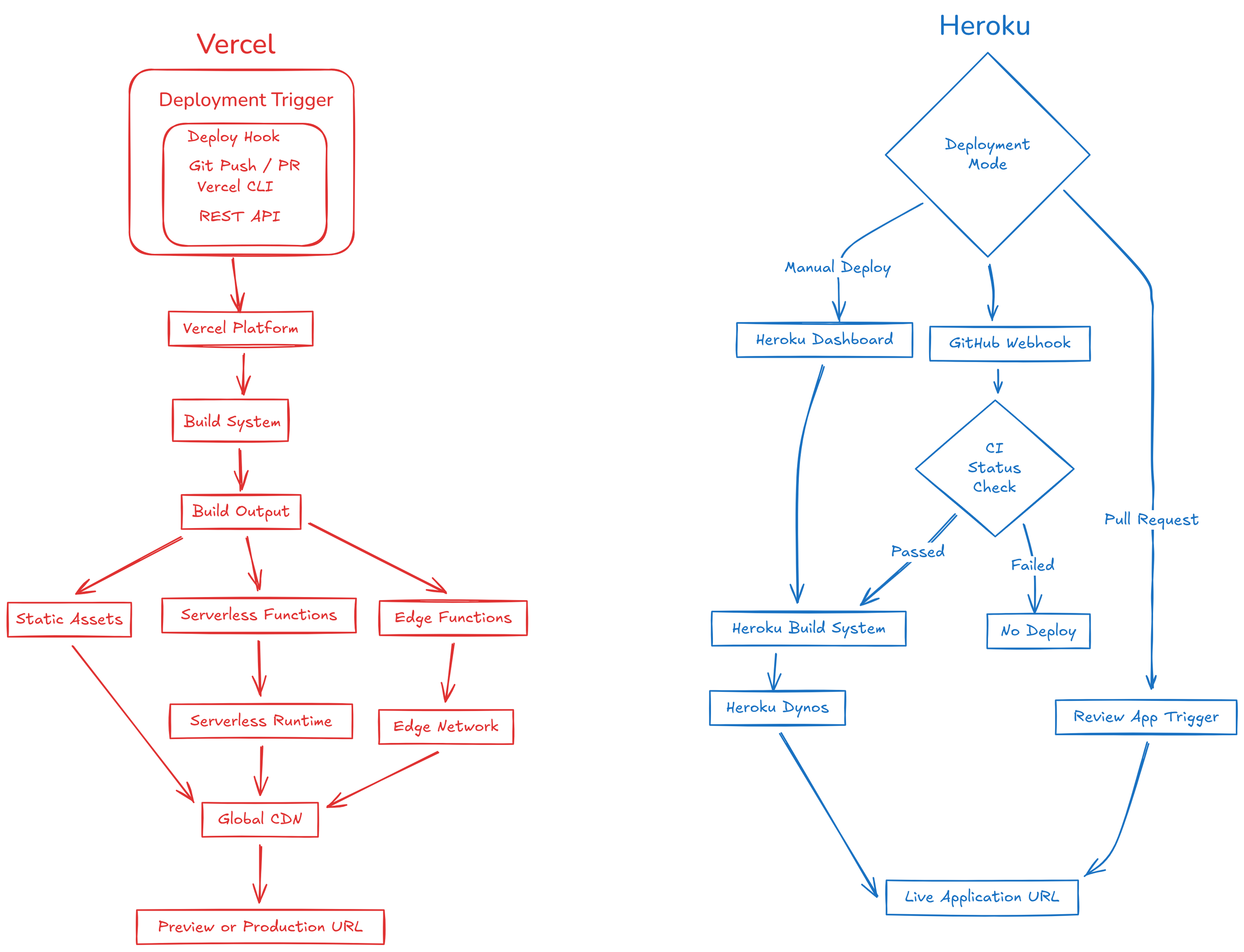
The deployment experience differs substantially between these platforms, though both aim to make deployment as straightforward as possible.
Heroku pioneered the Git-based deployment workflow. To deploy to Heroku, you typically connect your Git repository to Heroku and push your code using git push heroku main. Heroku automatically detects your application's language using buildpacks, installs dependencies, and starts your application. This workflow is intuitive for developers already familiar with Git and provides a clear mental model of deployment as a simple code push. Heroku also supports continuous deployment from GitHub repositories, automatically deploying when changes are pushed to specific branches.
The Heroku platform provides a Procfile mechanism for defining how your application should run.
Vercel takes deployment automation even further, with particularly seamless integration for frameworks it supports natively. When you connect a Git repository to Vercel, every push triggers an automatic deployment with a unique preview URL. This makes it incredibly easy to review changes before they go to production. Merging to your main branch automatically deploys to your production environment. Vercel's build system automatically detects your framework and applies appropriate build configurations, often requiring zero configuration for popular frontend frameworks like Next.js, Create React App, or Nuxt.js.
One of Vercel's standout features is its preview deployments. Every pull request gets its own deployment URL, complete with production-like infrastructure, making code reviews more effective and allowing stakeholders to interact with changes before they're merged. Vercel also makes it easy to attach custom domains to both production and preview deployments with automatic SSL.
Heroku vs Vercel: Their primary use cases
Understanding where each platform excels helps clarify which might be the better choice for your specific needs.
Heroku shines for traditional web applications, particularly those built with backend frameworks like Ruby on Rails, Django, Express.js, or Spring Boot. If you're building a monolithic application, an API server with complex business logic, or an application requiring persistent connections like real-time chat servers, Heroku provides the infrastructure and flexibility you need. The platform is also well-suited for applications requiring background job processing, scheduled tasks, or applications that need to integrate with specific databases or services through Heroku's extensive add-on marketplace.
Development teams working with polyglot architectures appreciate Heroku's multi-language support. This multi-language support makes Heroku attractive for teams running complex backends across different stacks. You can run different components of your application using different technologies, all within the same platform ecosystem. The add-on ecosystem is particularly valuable for teams that want managed services for databases, caching, monitoring, logging, and other infrastructure concerns without managing these services independently.
Vercel is the natural choice for modern frontend applications and full-stack JavaScript applications, particularly those built with Next.js. If you're building a static site, a Jamstack application, a React-based dashboard, or a marketing website with dynamic elements, Vercel's architecture delivers exceptional performance and developer experience. The platform's serverless functions are well-suited for API routes that support frontend apps, particularly for use cases like form submissions, authentication endpoints, or data transformations.
The combination of edge caching, automatic image optimization, and serverless functions makes Vercel particularly effective for content-heavy websites, e-commerce storefronts, and applications where global performance matters.
Security features in Heroku and Vercel
Security is a core concern for both platforms, but their approaches reflect different architectures. Heroku focuses on platform and workload isolation: applications run in isolated containers, HTTPS is supported via managed SSL certificates, and the platform includes network-level protections like DDoS mitigation (minimum protection). Heroku also emphasizes compliance and enterprise controls, with certifications such as SOC 2, ISO 27001, and PCI DSS. These guarantees extend to managed databases like Heroku Postgres, which inherit platform-level security controls by default.
Vercel, by contrast, follows a secure-by-default, serverless model. All deployments are automatically served over HTTPS, protected by a global edge network with built-in DDoS protection. Secrets are encrypted and scoped per environment (production, preview, development), preview deployments can be access-restricted, and enterprise plans add SSO, IP allowlisting, and deployment protection. Vercel maintains SOC 2 Type II compliance and provides fine-grained controls suited to frontend-centric and serverless applications.
Cost considerations
Understanding the cost structure of each platform is relevant for budget planning. Let's see the costs using an example of a full-stack application. Historically, Heroku offered free dynos, but today Vercel’s free tier is the more common entry point for developers experimenting or running small projects. So, for the sake of this example, we will be ignoring the free tier side of things because only Vercel offers some form of free tier.
Consider a full-stack application with a Next.js frontend with API routes, a PostgreSQL database, and Redis for caching.
Hosting
- Heroku: $25 (1× Standard-1X dyno, 512 MB)
- Vercel: $20 (1× Pro seat)
Postgres DB
- Heroku: $50 (Standard-0, 64 GB storage)
- Vercel: ≈$7 (20 GB at $0.35/GB) + compute (~$0–50)
Redis cache
- Heroku: $60 (Premium-2, 250 MB)
- Vercel: $0–$10 (Upstash free 256 MB tier or $10 plan)
Bandwidth
- Heroku: ~Free (up to 2 TB soft limit)
- Vercel: 1 TB included (then $0.15/GB)
Total (est.)
- Heroku: ≈$135
- Vercel: ≈$30–40
The Heroku total (~$135) assumes one dyno ($25), a Standard-0 Postgres ($50), and Redis Premium-2 ($60). Vercel’s total (~$30–40) is roughly $20 for Pro plus minimal DB/cache: Neon storage ($7) and possibly an Upstash plan ($5–10). Actual Neon compute usage (serverless scaling) could raise Vercel’s cost if the database is very active; likewise, as the app grows, heavy bandwidth or function invocation beyond free allowances could add fees.
If you take advantage of the free plan provided by Vercel, you may notice significant savings.
While the estimated Vercel total appears lower, it is important to understand how Vercel pricing scales. Unlike Heroku’s largely fixed, tier-based pricing, Vercel follows a usage-based model. The Pro plan includes a base monthly fee, but many resources are metered and billed linearly as usage increases.
Choosing the right platform for your team
Selecting between Heroku vs Vercel isn't about finding the objectively "better" platform; it's about identifying which one aligns with your specific needs. Heroku excels for traditional backend applications, supports multiple programming languages, has background jobs, and teams want an all-in-one cloud platform with a mature ecosystem. Vercel shines for modern frontend apps, static sites, Next.js projects, and teams prioritizing global performance and the seamless developer experience of automatic preview deployments.
The most pragmatic approach is to evaluate both platforms against your actual requirements. Consider your technology stack, team expertise, scalability needs, and budget. Many teams even pilot projects on each platform to experience the workflows firsthand. Remember that your choice may not be permanent. Some people reconsider their platform choice to reduce vendor lock-in, and both Heroku and Vercel make it possible to migrate. Many successful organizations often start with one platform and evolve their strategy as needs change. The platform that reduces friction, supports your stack, and enables you to deliver value quickly is the right choice for your team.
Whichever platform you choose, you'll want visibility into what's actually happening in production. Honeybadger works with both—full-stack monitoring that takes minutes to set up. Try it free for 30 days.

Written by
Muhammed AliMuhammed is a Software Developer with a passion for technical writing and open source contribution. His areas of expertise are full-stack web development and DevOps.